Conference Hall Seating Guides RSS Feed
Bereket Ofis manufactures conference and auditorium seating at its production facility in Istanbul and also offers repair, re-upholstery and spare parts. The guides in this section cover the questions that come up when a hall, lecture theatre or training room is being fitted out: which type of seat suits the room, how rows should be planned, what to specify for arms and writing tablets, and how to look after the seats once they are installed.
Fixed seating or movable chairs?
Fixed conference seating is arranged in rows and secured to the floor, which suits halls whose layout stays the same: conference halls, theatres and cinemas. Movable chairs, some of them stackable, suit seminar and training rooms that are reset between events. If the layout is permanent, see our conference seats; if the room has to be rearranged often, look at our conference and seminar chairs.
What to settle before asking for a quote
- Room use: a conference hall, lecture theatre, training room and boardroom each call for different arms and tablets.
- Capacity and row plan: the number of seats and a simple layout drawing are the basis of any quotation. For planning basics, see the seating dimensions and layout guide.
- Arms, tablet, cup holder: plastic or wooden arms, closed arms, a writing tablet or a cup holder change both use and cost.
- Upholstery: fabric or leather, and the colour, are best fixed early.
- Budget and specification: check early which documents your project specification asks for. For what shapes the cost of a seat, read the conference seat price guide.
Arms, tablets and upholstery in practice
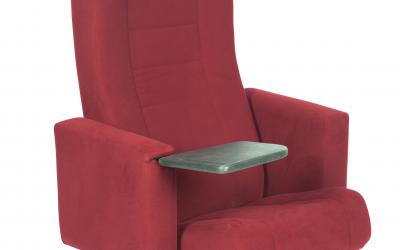
For rooms where people take notes, a tablet that stows under the arm keeps the row tidy; see the Rom conference chair with writing tablet. A plainer installation can use the Rom enclosed arm conference chair, a more distinguished look the Aras VIP conference chair, and meeting rooms and mid-sized halls the Dolfin meeting room chair.
Care, repairs and spare parts
Wipe metal and plastic surfaces with a damp cloth and dry them afterwards. Fabric stains can be treated with soap and water, but the foam underneath should not be soaked. Do not apply oil or grease to moving metal parts. Plastic covers that deform with age are replaced by removing and refitting four screws. For parts, see conference chair spare parts; for servicing, conference seat repair. If you are building a new hall, our conference hall construction page may help.
Frequently asked questions
What is the difference between fixed conference seats and stackable seminar chairs?
Fixed seats are secured to the floor in rows and suit halls with a permanent layout. Seminar chairs can be moved, and some models stack, which suits rooms that are reset between events.
What information is needed for a quote on hall seating?
The preferred model, the number of seats and the row layout, fabric or leather and colour, the arm material, and any writing tablet or cup holder. End-of-row arms are needed at installation; their number depends on the layout.
Does every hall need writing tablets?
No. They are useful in lecture and training rooms where people take notes. In halls used mainly for presentations or meetings, a model without a tablet gives a cleaner look.
Why choose a self-rising seat for tight rows?
The seat lifts by itself when the person stands, which makes it easier to pass along a row. It helps most in halls where people come and go often.
Can worn plastic parts or upholstery be replaced?
Yes. Plastic covers are replaced by removing and refitting four screws. We offer repair, servicing, re-upholstery and spare-part replacement.
To discuss a seat type or row layout for your hall, get in touch through our contact page.